Wednesday, November 28, 2012

Scandalous @ Neil Simon Theatre


It is magnificent how the actions of one can affect the lives of millions; one might even say that the concept itself is proof that miracles do exist. Miracle Aimee was one of the few blessed enough to have the power to change the world. It is difficult to decide whether or not the results of her own struggles show a corrupt fame-seeking woman or an evangelist preacher just trying to share the word of God with as many people as she could; but none can argue with the fact that she changed the life of anyone who encountered her. David Armstrong’s Scandalous, though hidden behind an overly extravagant set, presents Aimee Semple McPherson as someone who, like so many others, is just trying to struggle through the trials of life with the hopes of leaving an impression in the world.
Aimee Kennedy was born and raised on a farm in Canada. Her mother Minnie’s strict religious views constrain Aimee throughout her childhood while her father James Kennedy always seems loving to the young passionate girl. He even amuses her by taking her to a religious gathering held by missionary Robert Semple, who will eventually become Aimee’s first husband, much to her mother’s displeasure. The two take a missionary trip to China and Aimee’s life is changed forever when her young love dies of malaria immediately before she gives birth to their daughter. Aimee and her daughter move home to live with her now divorced mother and during this time she really began to question whether or not God really cared about her. She soon met her second husband, Harold McPherson, who later divorced her, and they had a son together. During this time Aimee has a reawakening with God and her faith is renewed. She begins to go out and preach the word of God. As her sermons became more popular, Aimee and her mother began traveling so that she could reach as many people as possible. Along the way she saved the lives of thousands, one of which was that of Emma Jo Schaeffer, a whorehouse owner, who stayed loyal to Aimee until her death. She also came into contact with many of the rich, the powerful and the famous, which was greatly beneficial to her ‘new’ way of approaching sermons. Aimee began to incorporate theatrics in order to attract a larger audience to the word of God. Her blatant disrespect of the ways of old, along with her affair with her soon to be third husband (and divorce) David Hutton, had older preachers such as Brother Bob in quite a state of despair. Even though pressure was pushing down on Aimee from all sides between her followers, the media and those like Brother Bob, she still managed to be the first women with her own radio license. Her use of the modern technology allowed her to be the first person to ever preach nationwide. Though Aimee’s achievements were great, they came at a terrible cost. Some time after her marriage with Hutton fell through, Aimee disappeared for almost a month. When found, she was brought to trial under the accusations of faking a kidnapping and committing adultery with her sound technician Kenneth Ormiston. The accusations of the trial were mysteriously dropped and Aimee was not arrested. The end of her life was an endless struggle to fight against the media and at this point her own sheer exhaustion. She died of an overdose, still preaching until her last breath. In looking at the tests Aimee faced in her life and the results of those tests, Scandalous questions whether or not her life, while full of sin, had enough repentance in it to be worthy of the praise she gained.
Armstrong’s Scandalous is a hard piece to sell due to it’s extremely controversial content. How does one give a biographical piece about a religious person without forcing the religion down the audience’s throats? With this cast, it is not difficult to see how Armstrong achieved such a spectacle. Carolee Carmello, starring as Aimee Semple McPherson, (The Addams Family) completely stole the hearts of everyone present. Her voice alone was phenomenal. On top of that her ability to switch between young Aimee into older more mature Aimee, into Aimee narrating her own life reflects her character’s own well known abilities as a preacher to hold an audience’ attention. Her love of God and sheer passion for making a difference is infectious. She completely embodied her character and it is doubtful that others could accomplish the same feat. Alongside her are Candy Buckley (After the Fall) and Roz Ryan (Chicago) as Minnie and Emma Jo respectively. Candy’s overpowering strictness could make God himself cower, and yet the audience can’t help but fall in love with her. The deep adoration she has for her daughter and for those in need shows that there is warmth under that icy interior. Roz Ryan’s character is one with a grueling past. Her struggles made her hard as stone, but Aimee found a soft spot and showed her the light. Though her character may have a religious epiphany, she doesn’t lose her witty sarcasm that never fails to get a good laugh out of the audience. Along with these three leading ladies are three equally talented men, George Hern, Edward Watts and Andrew Samonsky. George Hern (Wicked) played Aimee’s deeply affectionate father and contrarily, Brother Bob, Aimee’s rival preacher. Hern did a fantastic job at making her father so lovable and Brother Bob so awful. Brother Bob’s prejudices against Aimee and his determination to ruin her made blood boil. Edward Watts (Finian’s Rainbow) played Robert Semple and David Hutton. Though Watts looks the part of the dashing young Semple, his adoration for the lord seems to be only skin deep, which is a problem when playing a well-known religious missionary. It is difficult to imagine that someone seemingly lacking in the deep love of god could inspire someone as passionate as Carmello. Watts does a much more believable job as Hutton. The shallow, selfish and completely enchanting character made hearts swoon enough to distract from his many secrets. Playing opposite of Watts (as David) is Andrew Samonsky (South Pacific) as Kenneth Ormiston. Samonsky was charming, attractive and intelligent, everything that an older woman’s young lover should be. The audience couldn’t help but adore him, especially in comparison to Watt’s character’s true personality. Samonsky’s other character, Harold McPherson, was basically unmemorable. Whether intentional due to the fact that McPherson played a similarly forgettable role in Aimee’s life or unintentional, little can be mentioned of the character. Alongside these leads was a small but vocally very present cast including Sam Strasfeld (Mary Poppins), Joseph Dellger (The Gershwin’s Porgy and Bess) and Billie Wildrick (Broadway Debut), who appear in a variety of eccentric characters. The ensemble does a wonderful job of portraying the array of people Aimee came in contact with during her ministrations. Audiences experience everything from religious conservative farmers, and crazed followers to media reporters and whores. Overall the cast did a wonderful job of portraying the complicated life of Aimee Semple McPherson.
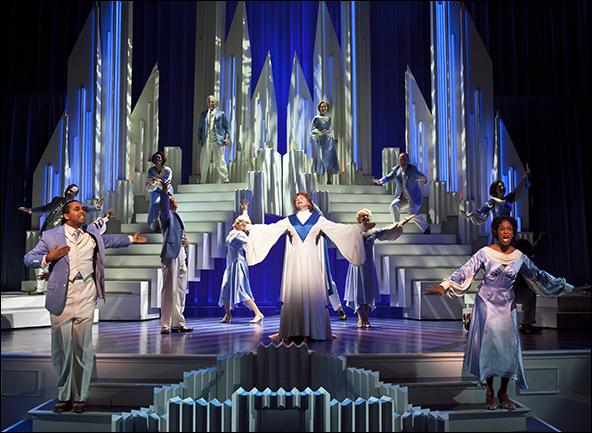
With strong direction under David Armstrong (creator of Hot N’ Cole) and a beautiful book by Kathie Le Gifford (of television fame – Today), one should not be surprised by the fact that the music by David Pomeranz (West End’s Little Tramp) and David Friedman (film’s Aladdin and the King of Thieves) was enjoyable. The only problem was that mere moments after leaving the theatre, it was near impossible to recall any of the songs. This can be attributed to an ensemble that, though sounding wonderful, was way too loud. Between Musical Director, Joel Fram (Wicked), or Sound Designer, Kevin Travis (Newsies), someone should have noticed that when the ensemble sang, the solo performers were lost completely. Along with difficulty in hearing, the ensemble pieces were accompanied by choreography, by Lorin Latarro (associate choreographer on American Idiot), that didn’t fit the show at all. Most of which was executed poorly. The choreography was very much contemporary while the show itself seemed to be following along the lines of what Aimee would have used to perform her sermons, theatrical but still conservative. The task of clothing the cast goes to Gregory A. Poplyk (Ringling Bros. Barnum & Bailey’s Dragons). His design concept seemed to work well with what the cast was doing. Aimee’s clothing in particular helped accentuate the drastic changes she went through as her life progressed from small town farm girl to a big life city preacher. The most prominent problem with the technical aspects of the show was the scenic design by Walt Spangler (A Christmas Story). Though the set was beautiful and did the task it set out to do, which was replicate the amazement people must have felt walking in to Aimee’s Temple in LA, it was too much. The smaller pieces for individual scenes were great and the tent fabric worked wonderfully for her sermon, but audience members spent a lot of time straining to see around the monstrous columns that made up the proscenium of the stage. Though used very well, a lot of the action was lost in the extravagant set. Last but not in any way least, the task of lighting this ginormous set went to Natasha Katz (Once). The lighting for Scandalous, unlike much of the rest of the technical aspects, was great. Each new location was so distinctly different. The bright sunlight of the farm verses the dim of the city and the theatrical lighting during the sermons really brought a reality to the show.
Even though there were some major technical flaws, overall the cast and crew of Scandalous should be proud of the work they are doing. The powerful performance of Carolee Carmello and her fellow actors and ensemble leave the audience amazed at Aimee’s incredible achievements.  The piece speaks a lot about the amazing possibilities of life itself and audiences should definitely experience the wonder of Miracle Aimee in Scandalous.


Monday, November 26, 2012

The Mystery of Edwin Drood @ Studio 54


“There you are!” Do you like something funny? How about an incomplete murder mystery? Well if so then The Mystery of Edwin Drood is for you!
A Victorian English music-hall troupe is presenting its version of "The Mystery of Edwin Drood," – the last, unfinished novel by Charles Dickens. Since the author never reached the conclusion of his whodunit, and failed to write down the name of the murderer, each night's audience is asked to select him or her. The victim is the title character, a young boy (played by an actress, Stephanie J. Block). He disappears, and is presumed to have been done away with. Dickens offered a sizable number of suspects: John Jasper (Will Chase), Drood's opium-eating uncle; the mistress of the opium den, known as Princess Puffer (Chita Rivera); Drood's former fiancĂ©e, Rosa Bud (Betsy Wolfe), an exotic brother and sister from Ceylon (Andy Karl and Jessie Mueller), a seemingly kind minister (Gregg Edelman) and several others.
This very talented cast plays the tricky part of two different characters, the person in the musical, and the person playing the person in the musical. Throughout the performance each actor gets a chance to “break character” and show the other side of who they are. Stephanie J. Block (Anything Goes), plays the Young victim of Edwin Drood and the stage diva Miss Alice Nutting. Block gives a dazzling performance as Edwin Drood – she left the audience cry on the floor when she storms out of the theatre during her diva moment. Will Chase (televion’s Smash) portrays the musicals horrible villain John Jasper and Mr. Chive Paget. Chase plays the perfect villain as you watch him fight with his dueling personalities; he contributed the perfect balance of evil and comedy delivering a stunning performance. Jim Norton (Finian’s Rainbow) played the lovable Narrator of the show Mr. William Cartwright and is forced to play the quirky Chairman after one of the “actors” is pulled out of the show. Norton was adorable and created a perfect atmosphere for “both” shows. Chita Rivera (West Side Story) played the wonderful Princess Puffer/Miss Angela Prysock, the owner of the Opem dean and created a since of wisdom with that the actors around them really played off of.  Andy Karl (Legally Blonde) and Jessie Mueller (Shakespeare in the Park’s Into the Woods) played the foreign twins Neville & Helena Landless. Karl and Mueller played really well off of each other and created two really well developed characters. Although they played well together, Mueller not only shined with her partner and with the rest of the cast but she really stood out and stole the show, She is truly an up and coming Broadway Star.
            Scott Ellis (Harvey) really created something special while directing this amazing show. He payed attention to every details and filled up every gap and the audience was never bored from when the show started to when it ended. The scenic design by Anna Louizos (The Performers) was truly outstanding and inspiring. She filled the theatre with Christmas decorations and really made the audience feel like they were in the opera house where they were putting on “The Mystery of Edwin Drood.”  The light design by Brian Nason (Three Penny Opera) was not so inspired unfortunately. The audience could tell that he is very talented but that fact was overlooked as they were blinded by the flashing lights as they came in and during the intermission.
So if you find yourself in the city and are looking for both something funny and a murder mystery, head to Studio 54 and check out The Mystery of Edwin Drood. Hiss at the Villains, cheer for the heroes, and choose the Killer! It’s up to you to have a say and see who done it!


Sunday, October 21, 2012

Who's Afraid of Virginia Woolf @ Booth Theatre


Not a single audience member could hide from the games of George and Martha at Edward Albee’s Who’s Afraid of Virginia Woolf? now open at the Booth Theatre. Direct from Chicago’s Steppenwolf Theatre Company, this unique take on a well known Albee classic – directed by Tony-nominated Pam MacKinnon – had members of the audience on the edge of their seat as they quickly became participants of wild party games that expose the innermost truths within us.
…Virginia Woolf takes us into the “dump” of a home of the dynamic duo, George (Tracy Letts) and Martha (Amy Morton). George, an unfulfilled history professor at the local college, and Martha, the witty daughter of the president of the college, invite over a new professor and his wife for some after-party cocktails to welcome and get acquainted with the newcomers. Nick (Madison Dirks) and Honey (Carrie Coon), however, discover that their host and hostess are ready to serve more than Brandy and Bourbon. Through witty storytelling, clever romp, and playful banter, we learn the history of George and Martha including what keeps this couple going strong. Unlike most idealistic couples, their mind games through role playing and insulting each other are what fuels their passion and desire. Initially, we are led to believe that Nick and Honey are a sharp contrast of their hosts: young, idealistic, vital, new generation brilliance; however, throughout their night, we learn about the dark past of the young couple and find that these four human beings have much more in common than they originally thought. As the night progresses, these four become stripped of their dignity and forced to enter a world of honesty and truthfulness, leading us to believe that all games must come to an end despite the consequences.
The vibrant storytelling provided by Albee’s text could have easily fallen flat in unworthy hands; however, this was not the case. Tony-nominated Amy Morton (August: Osage County) bares the soul of Martha before she even appears onstage with a contagious laugh that bursts through the front door. I would be remiss to say that Morton creates a “likable” Martha, but that she makes this woman relatable. Martha becomes a woman that you could easily run into at a family gathering and become the life of the party with a story for every soul. The ease, poise, and timing of her moves has you hanging on every word spoken; this was key to the successful portrayal of every line of subtext that existed below the façade of the couple’s antics.
Pulitzer Prize- and Tony Award-winning Tracy Letts (playwright of August: Osage County) creates a George who matches Martha’s wit with a rough hilarity. Most notable is Letts’ ability to create an atmosphere where comfort and warmth could quickly transform into cold, bone-chilling fear in the blink of an eye. Letts’ George is eloquent and sophisticated with a shot of vulgarity that bursts out, demanding your complete attention. George not only gave you a history lesson, he made you a prisoner that kept you thirsty for more – a Stockholm-esque characteristic. Letts makes bold choices that take the character of George and his onlookers deeper into the psyche of humankind, forcing you to question when enough is enough.
As a couple, Morton and Letts have a fiery chemistry that can only be described as flawless. Rapid-fire insults, unscripted inside jokes in their physicality, and brutal honesty is what makes this couple not only believable, but loveable. You can’t help but laugh at the brutality of their “Georgie-boy” and “Yes, love” lines. While we understand that these two teeter on the brink of insanity, their love for each other is genuine.
Broadway newcomers Madison Dirks (television’s Chicago Fire) and Carrie Coon (television’s The Playboy Club) create exactly what the party needs, a young George and young Martha; complete with their own skeletons in the closet. Dirks creates a Nick that tries relentlessly to maintain face and integrity despite his youth, attempting to hide naivety. Unfortunately for Nick, his wife Honey has enough naivety to fill the entire college. Coon brings a not-so “mousy” interpretation of the character Honey, allowing her wild side to come up a bit sooner than maybe anticipated. Unlike George and Martha, Nick and Honey seem to already be in a bit a rocky situation in regards to moving on through life. Dirks and Coon exemplify this in a way that fits well with not only their portrayal, but in their chemistry with Letts and Morton.
Pam MacKinnon’s (Clybourne Park) overall direction is a crucial part to this unique production. The audience is taken on a 3-hour roller coaster ride that had you thinking ever second of whether you were going to a fall freely, slow down, accelerate and so on. The seamless transitions and game hopping is a must to keep the audience invested in these characters’ downward spiral. Something as simple as a hair pull, a lost temper, or an added glare made this production not just dynamic but distinctive; the stripping down of characters to their bare minds is essential.
To house this insanity is a cleverly pieced-together set as well as a simply effective light design. Award-winning Todd Rosenthal (The Motherfucker with the Hat) proves that sets today can be still be thoughtful and eloquent while being functional. This realistic set clearly proves that both Martha and George had a say in who was designing the room: some mismatched furniture and blankets, an expressionistic painting on one wall and a landscape painting on another, and Martha’s magazines along with George’s books and novels. The final element is a subtle yet effective light design by award winner Allan Lee Hughes (Clybourne Park). Like the set, the light design is very realistic but captivates each moment expressively without being distracting. Hughes creates subtle light changes that do not only match the action but intensifies and amplifies the characters’ anger, fears, and frustrations.
Steppenwolf’s production Who’s Afraid of Virginia Woolf? is a remarkable piece of art that will leave you breathless from the beginning of each act to the end. Every element of this production is intelligent, witty, clever, and enigmatic, which make for amazing theatre.


Saturday, October 6, 2012

Grace @ Cort Theatre


            Religion is a topic that people tend to stay away from when they are sitting around the dinner table.  Everyone has a different idea of how it all began and how it will all end.  One’s opinion can rapidly change if a miracle or tragedy finds its way into their life.  Craig Wright’s new play Grace, shows all of Broadway how easy it is to either find belief or lose it when the quality life starts to change.
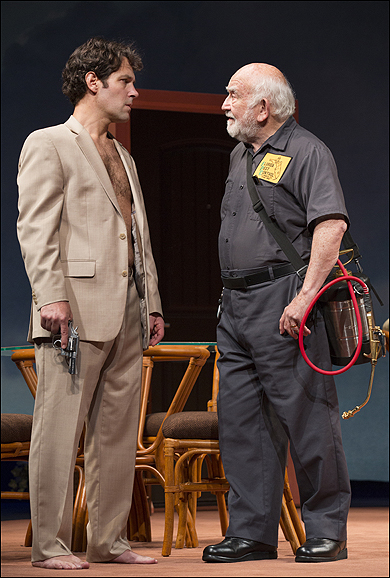
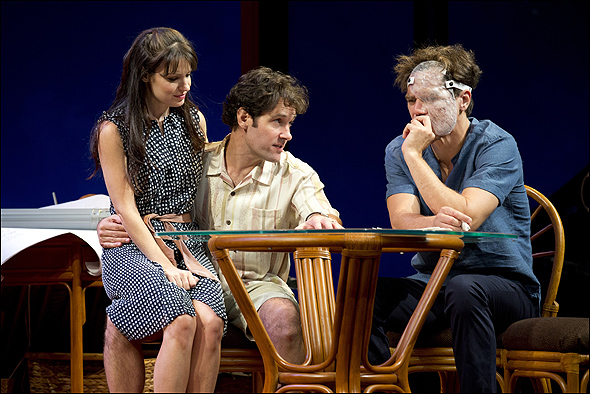
            The play is about a young married couple Steve (Paul Rudd) and Sara (Kate Arrington) who move to Florida in hopes of starting a new chain of Gospel themed hotels.  Steve has all of the plans in place, and is waiting to receive money from a wealthy investor in Sweden to give him the necessary money to start construction.  They are visited in the beginning of the play by an exterminator named Karl (Ed Asner) who proclaims them to be “Jesus Freaks” and Steve and Sara learn that not everyone shares their love for God.  Steve is forced to search for another source of funding for his hotel project while he is waiting for the Swedish investor, and turns to his next door neighbor Sam (Michael Shannon).  Sam is a NASA employee whose fiancĂ© died in a car crash and does not feel that he has a need for religion in his life.  Sara and Sam both stay at home all day and quickly become very close with one another.  The events of the play force everyone to rethink their idea of what religion means to them, while they fall in and out of God’s grace.
            Paul Rudd (I Love You Man) leads this star studded cast playing the role of Steve.  After .a lengthy hiatus from the Broadway stage, Rudd returns and is not in the least bit rusty.  Rudd was able to keep all of the light hearted comedic elements in his performance that he is known for, and masterfully blend them with his ability to be completely serious when he needed to be.  The different colors that he is able to put into his performance really allow his character to come to life.  He had great physicality, and it was very nice to see Rudd in a role that was a little more serious than that which he is used to.
            Steve’s next door neighbor Sam is played by Michael Shannon (HBO’s Boardwalk Empire).  Shannon was outstanding in this role.  He was able to capture his character’s injury and mentality almost flawlessly.  Even though Sam is kind of a jerk at first, Shannon does a great job of making the audience fall in love with him, making the end of the play more and more heartbreaking.  Both Rudd and Shannon are famous for a reason, and this play shows off just how good they are at their job.
            The love interest of both of those men in the play is Sara played by Kate Arrington (The American Plan).  In a cast with a great deal of star power, Arrington does a fine job of holding her own.  Arrington was very successful in playing opposite of Rudd.  Her ability to match his energy was superb.  Arrington’s character had a much more passive religious view, where Rudd was actively trying to get people to believe in God, and she did a very good job of providing a balance when he would try to push religion on either Sam or Karl.  Even though she is the least known member of the cast, the performance that she gives is just as good as anyone else.
            7 time Emmy Award winner Ed Asner (Lou Grant) played the role of Karl the exterminator.  Even though he was only on stage in in the beginning and towards the end of the play, his performance was both moving and very funny.   His journey into finding a higher power is possibly the most interesting.  Asner gives everything he says a great deal of importance, and he is just fun to watch while he is performing.
            A great show can only be as great as its director.  Dexter Bullard (Circle Mirror Transformation Victory Gardens Theater) made some tremendous staging choices that served the play very well.  The most important one was having the both Sam’s and Steve’s apartments exist in the same space.  This created moments on stage that would have never been realized if they were physically in two separate parts of the stage.  It was a brilliant choice by both Bullard and scenic designer Beowulf Borrit (The Scottsboro Boys), and the play would have not been as good as it was without the spacing being set up in the manner that it was.
            Grace was most certainly a play that is worth seeing.  It has something for both the people who want to laugh and the people who want to leave the theater thinking about something.  Everyone involved in the production skillfully demonstrates their abilities, and the audience is rewarded with the wonderful piece of theater that the cast and crew has created.