Showing posts with label David Henry Hwang. Show all posts

Tuesday, February 25, 2014

Kung Fu @ The Pershing Square Signature Center/Irene Diamond Stage

Bruce Lee almost single handedly created the “martial arts” action films. His name echoes throughout the world as a hero and superstar. So it’s no surprise that when his life is put on stage in “Kung Fu”, the result is a magical dynamic portrayal of a remarkable man.

“Kung Fu”, written by David Henry Hwang and directed by Leigh Silverman, takes the audience through the life of Bruce Lee (Cole Horibe) from the 1940s to 1971, when Bruce was starting his climb to superstardom. Deftly weaving through the past and the future, Bruce has to contend with trying to make his mark in a discriminatory world and still provide for his wife (Phoebe Strole) and family, while against the shame and troubled relationship Bruce had with his father, Hoi-Chuen (Frances Jue), along with other setbacks in his life.

The overall stunning cast is led by the dynamic Cole Horibe as Bruce Lee. In his New York theatre debut, Horibe is spunky, funny, and full of charm, passion, and intensity. He has exquisite control of his body, easily sliding in and out of kung fu and a myriad of other dance styles. This is exemplified in the opening scene where we see Bruce flirt with a contemporary dancer (Kristin Faith Oei) by combining cha-cha with contemporary and then throwing in his martial arts skills, all while never losing his charm and spunk. The scene greatly endears Bruce to the audience and that enjoyment remains consistent throughout the show. 
The rest of the cast is solid as well, in particular Phoebe Strole as Linda, Bruce’s wife, and Clifton Duncan as James Coburn and various other parts. Strole is a delightful foil to Horibe, listening intently to Bruce’s passionate speeches and showing her indomitable inner strength just when Bruce needs it the most. As the only female lead, the more subtle female inner strength that Strole portrays is striking in a show dominated by the physical strength of men. Clifton Duncan is just a delightful comic presence and frequently stole whatever scene he was in with just a simple look. My one critique of the cast is that it needed more women. Aside from Strole, the only other woman was ensemble member Kristin Faith Oei. While I understand the focus on Bruce and his broken relationship with this father (a wonderfully nuanced and malicious Francis Jue), along with Bruce’s relationship with his son and his film career, the female presence was needed more.

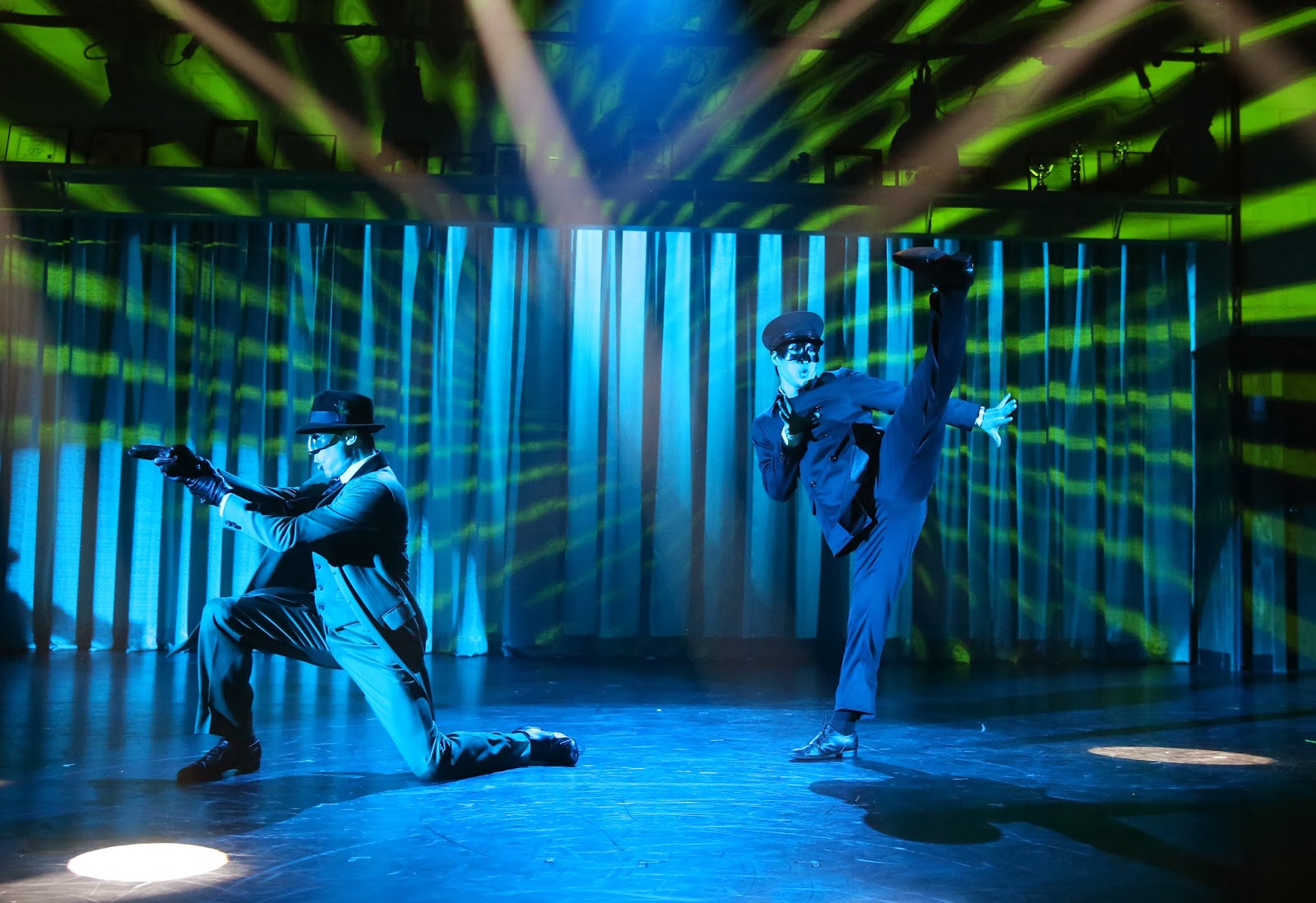
Besides the overall wonderful cast, the real star of “Kung Fu” was the choreography by Sonya Tayeh and fight direction by Emmanuel Brown. Once again, the opening scene set the tone of the choreography, which frequently turned on a dime between various genres and styles of dance. The fighting itself was also a dance, exemplified in sparring scenes as well as the more structured fights, like a heart racing street fight representing Bruce’s early wild days in Hong Kong. Sometimes it was hard to tell when the fighting ended and the dancing began, which shows the attention to detail director Leigh Silverman gave to every second of the show. Particularly stirring were two scenes between Young Bruce and his father in Act One, which was then mirrored in Act Two with the older Bruce. There’s so much said – hope, desperation, anger, disappointment, contentment – in almost no words, just in the movement.

In combination with the choreography, the lighting design by Ben Stanton and the music composed by Du Yun skillfully set up transitions between scenes and times that quickly established the moods for each scene. One particular stand out was the brightly comic colors and bouncy fun music used to create the “Green Hornet” section of the show, which turned up the comic book cheesiness in a truly funny and amusing way.

“Kung Fu” is a delightfully funny piece of theatre that truly encapsulates the rise of a now international recognized hero. Do not miss “Kung Fu” a wonderful gem of theatre. “Kung Fu” opens on February 24 and is only running until March 30 on the Irene Diamond Stage at the Pershing Square Signature Theatre on 480 West 42ns Street, between 9th and 10th Avenues.

Review By: Chrissy Cody

Photos By: Joan Marcus

Friday, November 4, 2011

Chinglish @ The Longacre Theatre


More and more, it is impossible to find a product that reads “Made in the U.S.A.”  Ch¢ing×lish, the new comedy from David Henry Hwang (Tony Award winner for M. Butterfly), explores the ideas of overseas business.  While at first, this concept might now seem to be the most interesting of material, Hwang successfully blends comedy, passion, English, and Chinese to form Ch¢ing×lish, currently playing at the Longacre Theatre.  This piece, however, must come with a disclaimer – due to the fact that there is a great deal of the piece spoken in Chinese with the English translation projected on the walls of the set.  So, if you are ready to do some reading, Ch¢ing×lish is a unique theatre experience that really takes risks that pay off.
Daniel Cavanaugh is an American business man trying to establish business in China.  With the city of Guiyang preparing to open a brand new state of the art theatre, Daniel plans to enter this city and pitch perfectly translated signs for the theatre.  After enlisting the help of an English man who speaks fluent Chinese, Peter Timms, Daniel enters his first big business meeting in China.  The head of the operation Minister Cai Guoliang and Xi Yan seem to positively react to Daniel’s proposal; however, as the scenes progress, it becomes clear that not everything is as straight forward as it seems.  Relationships are twisted, personalities are stretched, and families are pushed to the brink.  In the end, everyone is forced to understand Ch¢ing×lish, a combination of language, culture, and business.
With a very relaxed and laid-back persona, Daniel is portrayed by Gary Wilmes (Adam Rapp’s Red Light Winter).  Wilmes starts the piece with a very strong voice and personality – taking a clam command of each situation, from business to love.  This personality, however, never reaches new levels; as dramatic and life changing events happen in Daniel’s life, he never shares any emotion above clam – leaving the whole performance feeling a bit flat.  This flatness was brought further into light when acting side by side with the beautiful and talented Jennifer Lim (film’s 27 Dresses and television’s The Good Wife) as the determined business woman in a man’s world, Xi Yan.  Lim takes control of the stage in each and every scene, commanding attention and focus.  Lim takes Yan to new dimensions that leave the audience longing for her success and happiness – especially when the reason behind her twisted games is revealed.  Lim combines Chinese and English to truly representing the meaning behind the title, Ch¢ing×lish.  Minister Cai Guoliang, the head of the company developing the theatre and Xi Yan’s boss, comes to life by Larry Lei Zhang (a graduate of the Shanghai Theatre Academy).  Zhang delivers an entire performance in Chinese; however, with great expressions and larger than life movements, Zhang could do the entire performance without the provided subtitles.  His mannerisms were clear and direct making his performance highly entertaining and exciting to watch.  Unfortunately, Stephen Pucci (Royal Opera House’s Absent), playing interpreter Peter, falls victim to the flat lining syndrome that effected Wilmes. His approach to the character is full of life and importance; however, it never develops from there.  Pucci and Wilmes never take their characters on a journey throughout the piece, leaving the end result no different from point one.  Props have to given to the rest of the Ch¢ing×lish ensemble – constantly coming in and out of scenes as different characters each with a strong intent and direction is not easy; however these three actors do a truly brilliant job.
Ch¢ing×lish features direction from Leigh Silverman (Well) that is well focused and nicely done.  While some scenes fall a bit flat with actors simply sitting in chairs and not moving for a few minutes at a time, these mistakes can be forgiven for when the strong movements come into play.  Moving actors around a crazy good scenic design, creates the illusion that there is life outside of the four walls that the main characters live in.  David Korins (the current Godspell and An Evening with LuPone and Patinkin) takes the piece to a new level with his extremely intricate and rotating scenic design.  Moving from one location to another, Hwang’s script calls for many scene changes and different locations, each spinning on and off with ease and moving ensemble members to create scenes during the scene changes.  With walls and accessories appeared to be pulled right from the pages of a Chinese magazine, Korins delivers some stunning work.  Jeff Sugg (33 Variations) and Shawn Duan (Yo Gabba Live!) team up to create the extremely important projection design for the piece.  With each line of Chinese needed to be translated for the audience, Sugg and Duan produce projections that flow with ease and are easy to read and follow.  The piece is over all directed and designed nicely with great intent and strong story telling.
Ch¢ing×lish takes a strong risk in entering the world of Broadway.  Will theatre goers be able to connect to a story where over half is spoken in a different language?  The answer is yes they most certainly can!  With a powerful script, strong characters, and nice design, Ch¢ing×lish unleashes a new fusion of language to the American public.  Bring your glasses, get ready to read, and share a laugh because this is definitely a piece for theatre fans to check out.