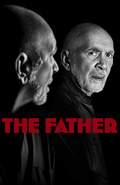
A good piece of theater will leave its audience walking away with something to talk about. A great piece of theater will leave its audience having a full-out discussion. Theatre For A New Audience's productions of Strindberg’s The Father and Thornton Wilder's translation of Ibsen's A Doll's House in repertory leaves its audiences having full out debates!
Both productions are presented on a transverse stage, with the audience both in front and behind the stage, allowing us a more natural way to observe these two stories, both focusing on the issues in two marriages. It is rumored that Strindberg’s The Father was written in response to Ibsen's A Doll's House. Though on the surface both shows appear to be opposites of one another, they actually go hand in hand. They present opposing viewpoints on very similar issues: how a marriage is affected by money, children, power, respect, and, arguably, mental health.

TFNA’s staging for A Doll’s House is mostly bright and refreshing (which is not how I interpreted the play when I read it back in high school!). Maggie Lacey’s portrayal of Nora begins effervescent and carefree. Lacey is onstage for about 90% of the show, and spends most of her time in motion. As it is revealed that Nora has a secret about just how she earned the money to cover expenses for her husband’s recovery from illness, we see a change in Nora. She does not want Torvald (portrayed by an extremely charming John Douglas Thompson) to find out she forged a signature for the loan, and we see her demeanor transform. Torvald’s status as the president of a bank would be ruined if it were revealed his wife committed a forgery to get money. We see Nora go from blissfully unaware, to panicked, to a full depressive state. Until this point, Nora was kept mostly in the dark about “serious” matters: she never was to worry of handling money or watching her own children. Her life is set in front of her in such a way that she does not need to make any heavy decisions. Thompson’s Torvald is sincere; it is very clear he loves his wife and only wants to take care of her. But when he learns of Nora’s forgery, his reaction is not to think that his wife wanted to take care of him for change, but that his life is over because his reputation is tarnished. In this moment we the audience (and Nora) realize this marriage is not based on mutual respect. Nora then makes a decision heavier than any other she has had to in her life. The final moments of the play are a jarring and emotional experience.
 The Father, similarly, comments on the importance of mutual respect between husband and wife, but on a more severe level. Adolph (again by Thompson) is a successful Cavalry Captain and a scientist who holds power in all aspects of his life except in his own household. His wife Laura (portrayed by a now fiery Lacey), argues with him on the life path they each want for their daughter Bertha (Kimber Monroe, who somehow seems to be the perfect blend of Thompson and Lacey). Adolph wants a sensible, responsible life for his daughter: to become a teacher so she can support herself if she remains unmarried and to know good skills if she chooses to become a mother. Laura, alternately, wants her only child to remain home and focus on her art. Laura is so headstrong in her desire; she will stop at nothing to get her way. She is manipulative to the point where it’s almost abusive. As a last resort, she plants the seed in Adolph’s mind that he may not even be the father of her child. This sends Adolph in a downward spiral, because it is pointed several times throughout the text that a man could never truly know whether or not a child is actually his. Adolph’s change in demeanor is much more sudden and apparent than Nora’s; it is established that both Adolph and Laura have known for years they have lost mutual respect in their relationship. “What happened to us?” he asks. She replies simply with, “Marriage.” We see Adolph spiral swiftly into the madness Laura has been telling doctors he has, to the point of moments that are heart-wrenching. One particular moment between Adolph and Bertha elicited a collective gasp from the audience. Whether Adolph’s madness has been present all along as Laura suggests, or if it had developed from the emotional abuse is unclear. That does not make his downfall any less upsetting to watch.
  TFANA’s mission as a company is to bring classic works of theater to audiences who are younger or not as familiar with the pieces in a way that is engaging and memorable. Running A Doll’s House and The Father in rep leads to a unique theater experience. TFANA created two pieces of theater that very easily inspire a dialogue. I attended on a day where both plays were being performed, which resulted in a deep discussion with my guest of how each script related to the other on our trip back home. A talk back after the matinee of A Doll’s House went from a typical Q & A to the actors about their experience to a full-out debate on Nora’s maturity, possible narcissism, and the validity of her decisions. THIS is the mark of an exceptional piece of theater: memorable, thought-provoking, able to ignite a passionate discussion.
Thompson and Lacey give some of the most distressing, high-energy portrayals of husband and wife since Burton and Taylor in Who’s Afraid of Virginia Woolf? Though each production easily stands on its own, it is highly recommended to see both, if for nothing else than to see the lead actors each play two very different characters with the same level of ease and finesse.
A Doll’s House and The Father run through June 12th.
Review By: Kelcie Kosberg
Photos By: Gerry Goodstein